The Sun: Our First Clock
Published on October 5, 2025
Ever wonder how people knew when it was lunchtime before clocks even existed? Long before your phone screen lit up with the time, humanity looked to the grandest clock of all: the sun.
Nature's Clock
The very first "clock" wasn't an invention at all—it was the sky. Early humans tracked time by the simple, reliable rhythm of nature: the sun rising and setting, the moon changing its shape, and the seasons rolling by. This gave them a general sense of the day, but they needed something more precise.
The First Invention: Chasing Shadows
Around 3,500 years ago, the Ancient Egyptians had a brilliant idea. They noticed that as the sun moved, the shadows cast by objects moved with it in a predictable way. By sticking a tall post or obelisk in the ground, they created a shadow clock. The length and position of the shadow told them what part of the day it was—morning, noon, or afternoon. This simple idea evolved into the sundial.
What is a Sundial and How Do You Read It?
A sundial is a device that tells time by using the sun's position. It has two main parts:
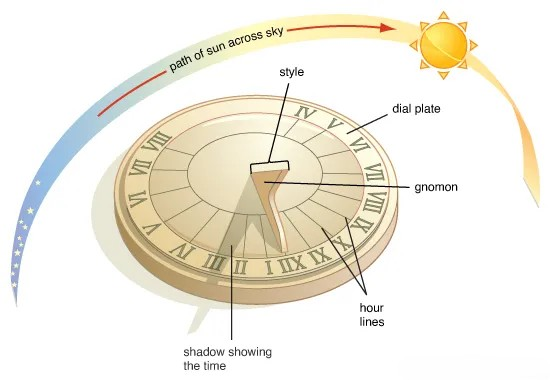
Reading it is simple: The sun shines on the gnomon, which casts a shadow onto the dial. Whatever number the shadow points to is the time of day. As the sun moves from east to west, the shadow sweeps across the dial, pointing to each passing hour.
The Evolution from Sun to Gears
The sundial was a genius invention, but it had a major flaw: it didn't work at night or on cloudy days. This pushed people to invent new timekeepers that didn't rely on the sun. First came water clocks, which used the steady drip of water to measure time. Then, around the 14th century, the first mechanical clocks were invented in Europe. Using a complex system of weights, springs, and gears, these massive tower clocks gave birth to the "tick-tock" sound we know today and, for the first time, allowed entire towns to sync their lives to the same hour.
From a simple shadow on the ground to the intricate gears of a clock, our journey to measure time has always been about bringing a little more order to our world.