Time in a Trickle, a Flame, and a Whisper
Published on November 12, 2025
The Clock That Dripped All Night
Sundials were brilliant, but they had a big problem: they took the night off and didn't work on cloudy days. So, how could you tell time in the dark? Ancient inventors got creative and looked to the steady, predictable flow of water. This led to the creation of the water clock, known by its cool Greek name, the clepsydra, which means "water thief."
How the "Water Thief" Worked
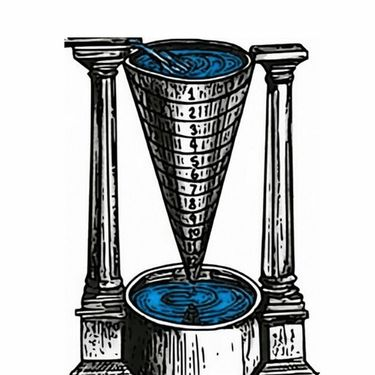
The design was simple but incredibly clever. It was basically a stone container with a tiny hole near the bottom. Water would drip out of the hole at a constant, steady rate. As the water level slowly lowered, it would pass markings on the inside of the vessel that represented the hours. Whichever line the water level was at told you the time!
This was a huge breakthrough. For the first time, timekeeping was possible 24/7, whether it was sunny or raining. The simple but effective design was used for centuries and perfected by ancient cultures like the Greeks and Romans, paving the way for even more complex clocks in the future.
Time in a Bottle: The Hourglass
While it feels like an ancient invention, the sand clock, or hourglass, is a more recent development than the water clock, becoming common in Medieval Europe around the 14th century. The hourglass became the sailor's trusted companion on the high seas. A perfect "time in a bottle," its steady flow of sand was unfazed by a ship's rocking motion or the freezing cold, making it far more reliable than a water clock. On land or at sea, a simple flip resets the clock.
Time by Fire and Fragrance
Meanwhile, in ancient China, time was measured by fire and fragrance. Marked candles burned at a steady pace, with lines in the wax indicating the passing hours. Cleverly, a nail could be pushed into the candle at a specific mark; when the wax melted, the nail would clatter onto a metal plate, creating a simple alarm clock.
Even more sophisticated were the incense clocks. A winding trail of powdered incense would smolder in an ornate box, following a maze-like path. At set intervals, the glowing ember would burn through a silk thread, releasing a tiny bell that would chime softly, marking time with a gentle, fragrant whisper.
From the "water thief" of Greece to the fragrant chimes of China, these inventions were a testament to human creativity. They showed that time wasn't just something to be seen in the sky, but a force that could be felt in a steady drip, a patient grain of sand, and a whisper of smoke.